




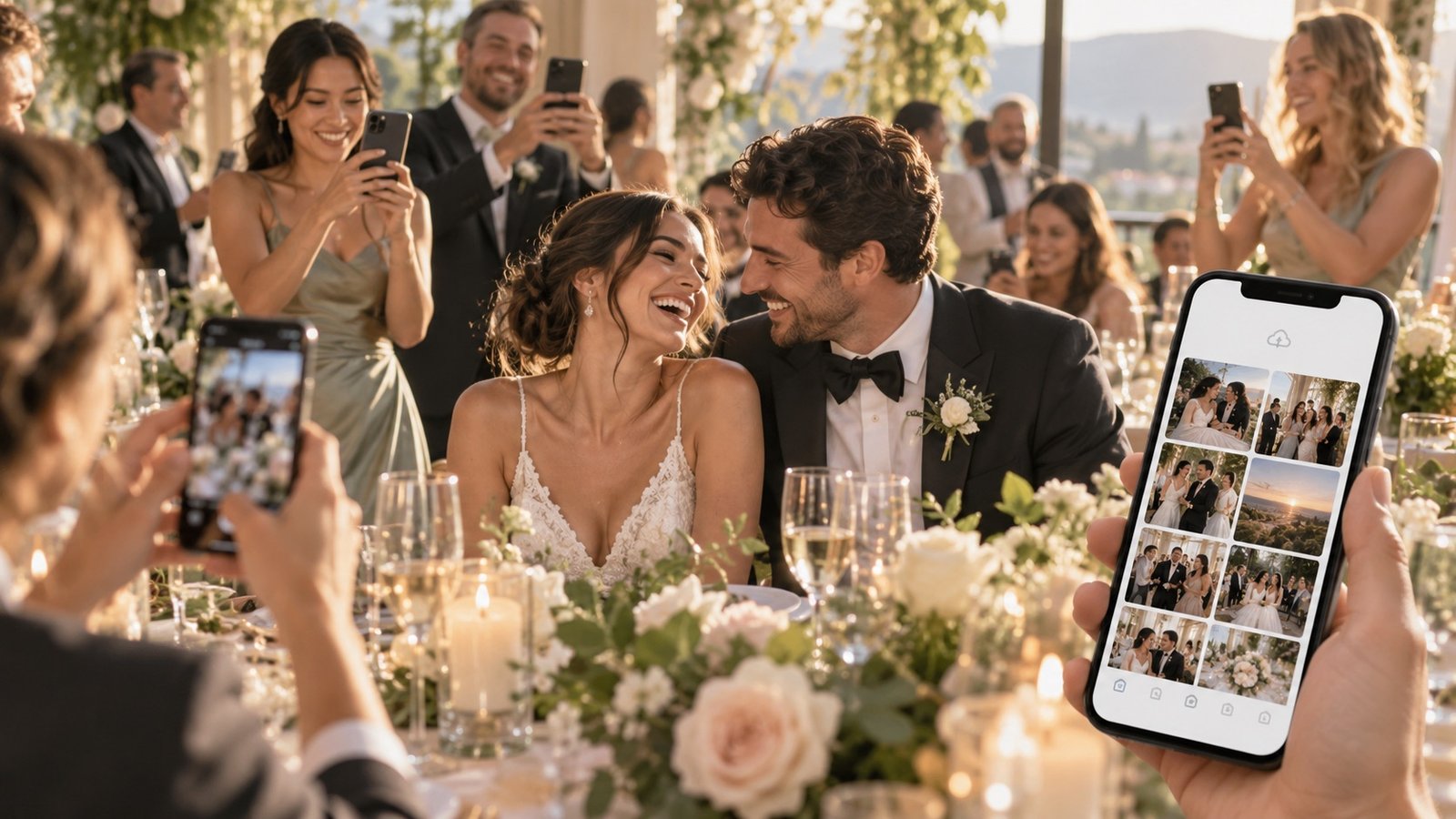

A wedding is photographed from two very different points of view. The professional photographer is responsible for the moments that cannot be missed: the ceremony, portraits, family groups, details, entrances, rituals and all the small transitions that hold the story together. Guests photograph something else. They capture what happens beside the official frame: a cousin fixing a dupatta, a child asleep on two chairs, friends laughing in the corridor, a parent watching from the edge of the dance floor, or the chaos in the car between venues.
Both sets of photographs matter, but they should not be treated as the same thing. Professional coverage needs planning, consistency and responsibility. Guest photographs are valuable because they are loose, personal and unpredictable. The best workflow keeps those roles separate while making it easy for the couple to preserve both.

Start by defining the role of guest photos
The first mistake is asking guests to “help photograph the wedding.” That sounds harmless, but it can create the wrong expectation. Guests may feel they are supposed to document key moments, move into aisles, interrupt portraits or hold phones above the photographer during the ceremony.
A better instruction is simple: enjoy the wedding, take the pictures you would naturally take, and share them later. That wording protects the photographer’s working space and also produces better guest pictures. People are much more interesting when they are reacting to the day than when they are trying to imitate the hired team.
This distinction is especially useful at large Indian weddings where several events may happen across different rooms, homes or venues. A photographer can cover the important story, but guests will still catch side moments during the haldi, mehendi, sangeet, baraat, family meals and late-night conversations. Those photographs are not a substitute for the professional gallery. They are the material around it.
Give the professional photographer priority during key moments
Any guest-photo plan should come with one clear etiquette rule: the professional team gets priority when a moment is being formally covered.
That means guests should avoid stepping into the aisle during the ceremony, leaning in front of the lens during rituals, blocking family group photographs, or stopping the couple in the middle of a portrait session to take their own version. A phone held up for a few seconds can be enough to spoil the angle the photographer has prepared for.
The strongest guest photographs usually come from places the professional team is not focusing on at that exact second. Think of the friends waiting outside the room, relatives getting ready, people reacting to speeches, the table where school friends reunite, or what happens after the official dance-floor photographs are finished.
In other words, the goal is not twenty copies of the same frame. The goal is twenty different viewpoints on the day.
Use one simple collection path instead of scattered chats
The collection method matters almost as much as the photographs themselves. If the couple asks guests to send pictures through several WhatsApp groups, Instagram DMs, email, AirDrop and shared drives, the archive becomes fragmented before it even begins.
A cleaner approach is to choose one guest upload path and make that the default. It can be a browser-based wedding gallery, a file-request folder or another service that fits the couple’s privacy and storage needs. What matters is that a guest can understand the process without a tutorial.
If a couple is still choosing a tool, this comparison of wedding photo sharing apps for guests looks at browser uploads, guest accounts, privacy, storage and original-file downloads so the collection method can be chosen before invitations or QR cards are printed.
Whatever tool is used, test the guest experience on both an iPhone and an Android phone before the wedding. Open the exact guest link while signed out of the host account. Upload a few sample photographs. Check whether the guest is asked to create an account, whether the upload confirmation is clear, and whether the host receives the original file as expected.
Place the sharing prompt where guests have time to act
A QR code is useful, but placement decides whether anyone uses it. A code at the entrance is easy to miss because guests are arriving, greeting people and finding their seats. A code that appears only on a large screen may disappear before someone takes out their phone.
Better locations are places where guests naturally pause: table cards, a small sign near the bar, the photo booth area, the welcome desk, a card inside the room, or a printed note near the guestbook. For multi-day celebrations, the same link can be repeated at each event instead of creating a new system every day.
The instruction should also be short. “Share your photos here” is usually enough. Avoid paragraphs about how the technology works. If a guest needs to read six steps before uploading, many will decide to do it later and then forget.
Protect file quality before it is lost
Guest photographs often lose quality because the couple receives them only after they have travelled through messaging apps. The original image may be sent to a group, downloaded by someone else, forwarded again, posted to a story, screenshotted and finally sent back to the couple.
By that point, the file may be compressed, renamed or stripped of useful information. Even when the image still looks fine on a phone screen, the original version is better for printing, cropping and long-term storage.
The simplest solution is to collect from the guest’s camera roll as directly as possible. Guests can still share pictures in chats for fun. The archive, however, should come from original files whenever possible.
Separate collection from curation
Couples often make the collection process too strict because they are worried about duplicates and blurry photographs. They ask guests to choose only their “best” images. That sounds tidy, but it adds friction at the worst possible time.
During the wedding, completeness is more useful than perfect selection. Let guests upload what they want. Curation can happen later, when the couple has time to remove accidental screenshots, repeated frames and obvious failures.
This also protects emotionally important photographs that would never win a technical contest. A slightly soft picture of a grandparent laughing may matter more in ten years than a perfectly exposed photograph of a centrepiece. The first question during curation should be: does this show something we would otherwise forget?
Keep the guest archive private until it has been reviewed
Collection and publication are two different decisions. A guest may be happy to share an image with the couple without expecting it to appear publicly on social media.
For that reason, the safest default is to keep the incoming collection private or moderated until the couple has reviewed it. This matters even more when the photographs include children, private family moments, religious rituals, people who prefer not to be posted, or pictures taken in getting-ready rooms and other personal spaces.
If the chosen gallery can show uploads to other guests, decide in advance whether new submissions appear immediately or only after approval. There is no single right answer, but the choice should be deliberate rather than accidental.
Organise a multi-day wedding by event, not just by date
Large weddings quickly produce hundreds or thousands of guest photographs. A single folder named “Wedding Photos” becomes difficult to browse even when every file has a correct timestamp.
A more useful structure follows the way people remember the celebration. Separate the collection into events such as mehendi, haldi, sangeet, ceremony, reception and after-party. If the wedding includes events at different homes or venues, those can be separated too.
This does not need to be complicated. The point is simply to avoid relying entirely on phone metadata. Screenshots, edited photos, downloads and time-zone settings can all change timestamps. Event-based folders give the archive a human structure even when the technical metadata is messy.
Build a simple handoff routine after the wedding
The first few days after a wedding are when most guest photographs are still easy to recover. People have the images on their phones, the event is fresh in their minds, and the couple can still send one polite reminder without it feeling late.
A useful routine looks like this: keep the upload link open after the wedding, send one reminder the next morning or within a couple of days, then download or back up the full collection to a location the couple controls. Do not wait until the gallery is about to expire before making the first local copy.
Keep an untouched originals folder before any heavy sorting. Then create a working copy for deleting duplicates and obvious mistakes. Finally, create a smaller favourites folder that is pleasant to browse or share with family.
That three-layer structure is simple, but it prevents the common problem of deleting the only copy of an image while trying to tidy the album.
Merge the stories without pretending they were shot the same way
When the professional gallery arrives, the temptation is to pour every image into one enormous folder. That can work for storage, but it often weakens the viewing experience.
Professional photographs usually have a consistent visual language. They are edited as a set, with deliberate colour, exposure and sequencing. Guest photographs may come from dozens of phones, filters and lighting conditions. Trying to make them look identical can remove the quality that made the guest pictures interesting in the first place.
A better approach is to preserve the professional gallery as its own finished body of work, then use guest photographs as a companion archive. For a family slideshow or printed memory book, selected guest images can be woven into the timeline where they add information the professional gallery does not have.
For example, the photographer may have a strong image of the bride entering the ceremony while a guest has a photograph of her father waiting just outside the door. Those two pictures belong to the same memory even though they were made with completely different intentions.
Look for story threads the official timeline missed
Guest photographs become especially valuable after the wedding because they reveal small stories nobody noticed in real time.
When reviewing the collection, look for repeated appearances of the same people, places or moments. Perhaps a group of college friends kept recreating an old photograph. Maybe the youngest cousin spent the evening following the band. Perhaps two grandparents sat together talking for an hour while the reception moved around them.
These clusters can become small albums of their own. They are often the photographs relatives come back to because they show the wedding from inside the guest experience rather than from the formal schedule.
Common mistakes to avoid
- Asking guests to act like extra photographers instead of simply sharing the moments they naturally capture.
- Using several collection channels at once and then spending weeks trying to gather the files.
- Letting guests block the professional photographer during the ceremony, rituals or portraits.
- Relying only on WhatsApp or social media copies when original files are still available.
- Publishing the guest gallery automatically without considering privacy.
- Deleting duplicates before an untouched backup has been made.
- Assuming timestamps and filenames will always be accurate enough to organise the entire archive.
A practical checklist for couples and photographers
- Tell guests that candid, ordinary moments are welcome, but professional coverage gets priority.
- Choose one main upload path and test it on real guest phones before the event.
- Place the QR code or sharing link where guests naturally pause.
- Collect original files directly where possible.
- Keep incoming images private or moderated until they are reviewed.
- Organise multi-day weddings by event as well as date.
- Back up the guest archive soon after the wedding.
- Preserve the professional gallery as its own finished body of work.
- Use selected guest photographs to fill the emotional and social gaps around the official story.
Final thought
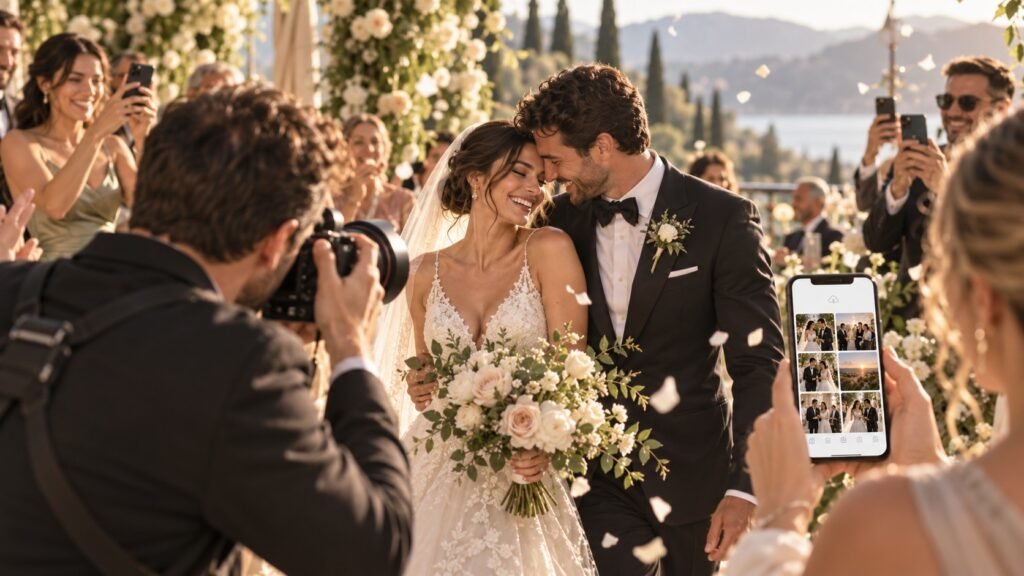
Professional wedding photography and guest candids solve different problems. One is commissioned to create a dependable, coherent record of the day. The other captures dozens of personal viewpoints that no photographer, however experienced, can occupy at once.
The best workflow does not ask one to replace the other. It gives the professional team room to work, gives guests an easy way to share what they naturally see, preserves the original files, and keeps the couple in control of the archive. When those pieces are handled well, the final collection feels less like a pile of photographs and more like the wedding as people actually experienced it.