




Wedding Photo Albums vs Digital Galleries: Why Printed Memories Still Matter
Wedding Photo Albums vs Digital Galleries: Why Printed Memories Still Matter? Somewhere between the excitement of getting married and the whirlwind of the celebrations that follow, most couples end up with the same thing: a link. A digital gallery, sent by the photographer weeks after the wedding, holding hundreds — sometimes thousands — of photographs.
It’s a wonderful thing to have. But it also raises a question that more couples are asking today than ever before: is a digital gallery enough, or does something get lost when wedding photographs live only on a screen?
So, when comparing wedding photo albums vs digital galleries, which option is actually better for preserving your memories? The answer depends on what you want from your photographs — but for most couples, the strongest approach is to keep both.
Digital Wedding Galleries vs Printed Albums: The Quick Answer
Neither replaces the other. A digital gallery is best for storing, sharing and accessing the complete wedding collection from anywhere. A printed album is best for turning a curated set of photographs into a physical keepsake that can be revisited without a screen. Most couples benefit from having both.
What Is a Digital Wedding Gallery?
A digital wedding gallery is typically a private, password-protected online space where a photographer uploads the full set of edited images from the wedding. Couples can browse, download, and often share the link with family and friends, who can then view or save their favourite photographs directly.
For many photographers, this has become the default way of delivering a wedding — quick, convenient, and accessible to everyone involved, regardless of where they live.
Where Digital Wedding Galleries Win
Easy to Share
A single link can reach relatives across cities or countries in seconds. There’s no need to courier prints or wait for someone to visit in person.
Access to the Complete Collection
Unlike a curated album, a digital gallery usually holds the full set of delivered photographs from the wedding — not just the highlights. This makes it valuable as a complete record of the day.
Convenient for Social Media
Couples who want to post photographs online can do so directly from the gallery, without needing to scan or photograph a printed image.
Easy to Download and Organise
Photographs can be downloaded, backed up, sorted into folders, or shared selectively — something a physical album simply cannot do.
The question isn’t whether digital galleries are useful — they absolutely are. The question is whether they should be the only way you experience your wedding photographs.
When a Digital Gallery May Be Enough
For some couples, a digital collection genuinely covers everything they need. If they travel often, live in a smaller space, share most of their photographs online, or simply prefer digital media over physical objects, a well-organised gallery can be a completely practical way to enjoy and revisit their wedding photographs. There’s no rule that says every couple needs a printed album — it comes down to how you like to experience your own memories.
Why Printed Wedding Albums Still Matter
1. They Turn Photographs Into a Physical Experience
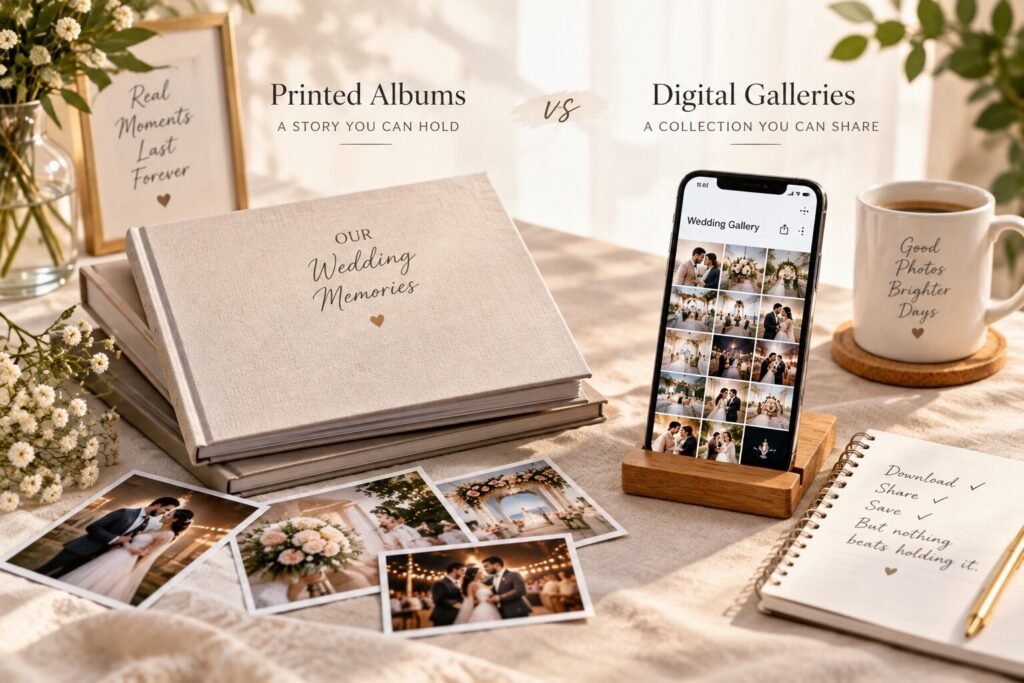
There’s a noticeable difference between scrolling through a folder and physically turning the pages of an album. A printed album slows things down and makes the experience of revisiting your wedding feel intentional.
2. They Create a Curated Story
A digital gallery is a collection. An album is a story. Choosing which photographs make it into an album — and in what order — naturally creates a narrative of the day, rather than an unfiltered archive.
3. They Are Easy to Share With Family
Not every relative wants to open a link, create an account, or scroll through hundreds of files. An album can simply be handed over, opened, and enjoyed together — particularly by grandparents or older family members who may be less comfortable with digital galleries.
4. They Don’t Depend on a Screen
A printed album doesn’t rely on a working device, an internet connection, or a link that hasn’t expired. It exists independently of any platform.
5. They Become Family Keepsakes
Albums tend to be kept, displayed, and passed down in a way that digital files rarely are. A well-made printed album can become a long-term physical keepsake that outlives changes in technology.
Wedding Photo Albums vs Digital Galleries: At a Glance
| Factor | Digital Wedding Gallery | Printed Wedding Album |
| Number of photographs | Usually the complete delivered collection | Curated selection |
| Sharing | Easy to share online | Best for sharing in person |
| Accessibility | Phone, tablet or computer | Physical copy |
| Storytelling | Viewer chooses how to browse | Deliberately sequenced |
| Social media | Convenient | Not designed for social sharing |
| Family viewing | Requires a device or link | Easy to view together |
| Personalisation | Gallery presentation | Layout, cover, size and paper |
| Best for | Complete collection and sharing | Preserving favourite memories |
| Long-term experience | Digital storage dependent | Physical keepsake |
Why Printed Albums Work Especially Well for Weddings With Multiple Celebrations
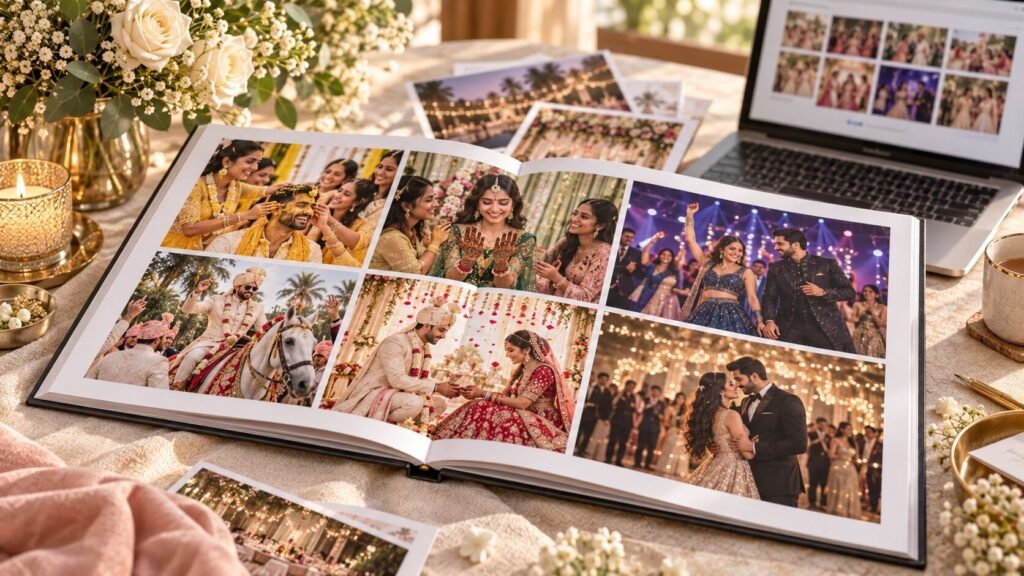
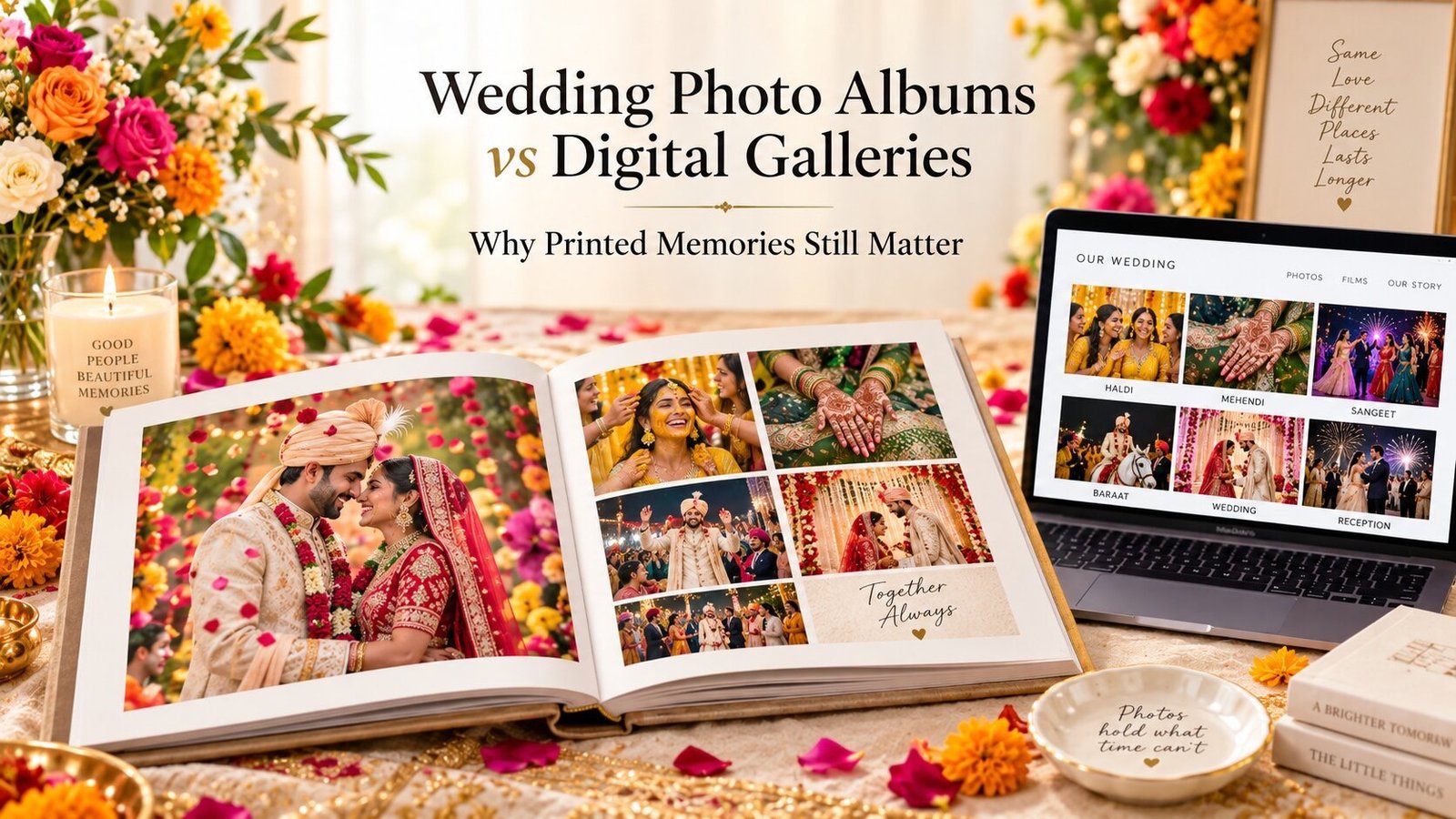
For couples whose celebrations include events like haldi, mehendi, sangeet, the baraat, the wedding ceremony, and the reception, a digital gallery can end up holding an overwhelming number of photographs spread across several days. A printed album gives you the chance to bring all of these moments together into a single, cohesive story.
One approach is to give each major celebration its own visual section within the album, using a few connecting photographs to move naturally from one event to the next — for example, moving from haldi to mehendi, then sangeet, baraat, ceremony, and finally the reception. This kind of structure helps the album feel like a journey through the wedding rather than a random mix of photographs.
How to Turn Your Digital Wedding Gallery Into a Printed Album
Step 1: Download Your Photographs
Start by downloading the full-resolution files from your photographer’s gallery, rather than working from compressed versions saved off social media.
Step 2: Back Up the Complete Collection
Before doing anything else, create at least one additional copy of the full collection in a separate location.
Step 3: Shortlist Your Favourite Images
Go through the gallery and shortlist the photographs that matter most to you — this will usually be far fewer than the total number of images delivered.
Step 4: Build a Story
Arrange your shortlisted images so they follow the flow of the day, rather than simply listing them in the order they were taken.
Step 5: Choose the Album Format
Decide on the size, orientation, page count, paper, cover, and binding style that suits your photographs.
Step 6: Proof the Final Design
Review the layout carefully — check cropping, faces, image quality, page order, and any captions before finalising.
How Many Photos Should Go Into a Wedding Album?
There’s no universal number, and any source claiming otherwise is oversimplifying. The right count depends on:
- Album dimensions
- Number of pages
- Image orientation
- Layout style
- Binding
- The kind of storytelling you want
As a general guide: a hero image might sit alone on a page, a two-page spread might hold one or two photographs, a standard storytelling page might use two to four, and a detail or candid collage might work with four to six. The guiding principle is simple — don’t try to fit every good photograph into the album. Choose the ones that move the story forward.
What Is Lay-Flat Binding and When Is It Useful?
Lay-flat binding allows album pages to open fully flat, rather than curving into the spine. This makes it particularly useful for wide venue shots, couple portraits, large group photographs, and any image designed to stretch across a two-page spread without an awkward crease running through the middle.
Couples looking to turn their digital photographs into a personalised physical keepsake can explore different wedding photo album formats and choose a design that suits their own collection.
What Makes a Wedding Photo Album Worth Keeping?
Not every album ages well. A good wedding album tends to share a few common qualities:
- It tells a coherent story from beginning to end
- It includes the people who matter, not just the couple
- It balances portraits with candid, unposed moments
- It avoids overcrowding pages with too many small images
- It gives the most important photographs enough space to stand out
- It uses paper and printing quality suited to how it will be handled and stored
- It reflects the personality of the couple, rather than following a generic template
Keeping these in mind while shortlisting and designing makes a real difference to how much the album gets used in the years afterward.
Which Photos Should You Include in Your Wedding Album?
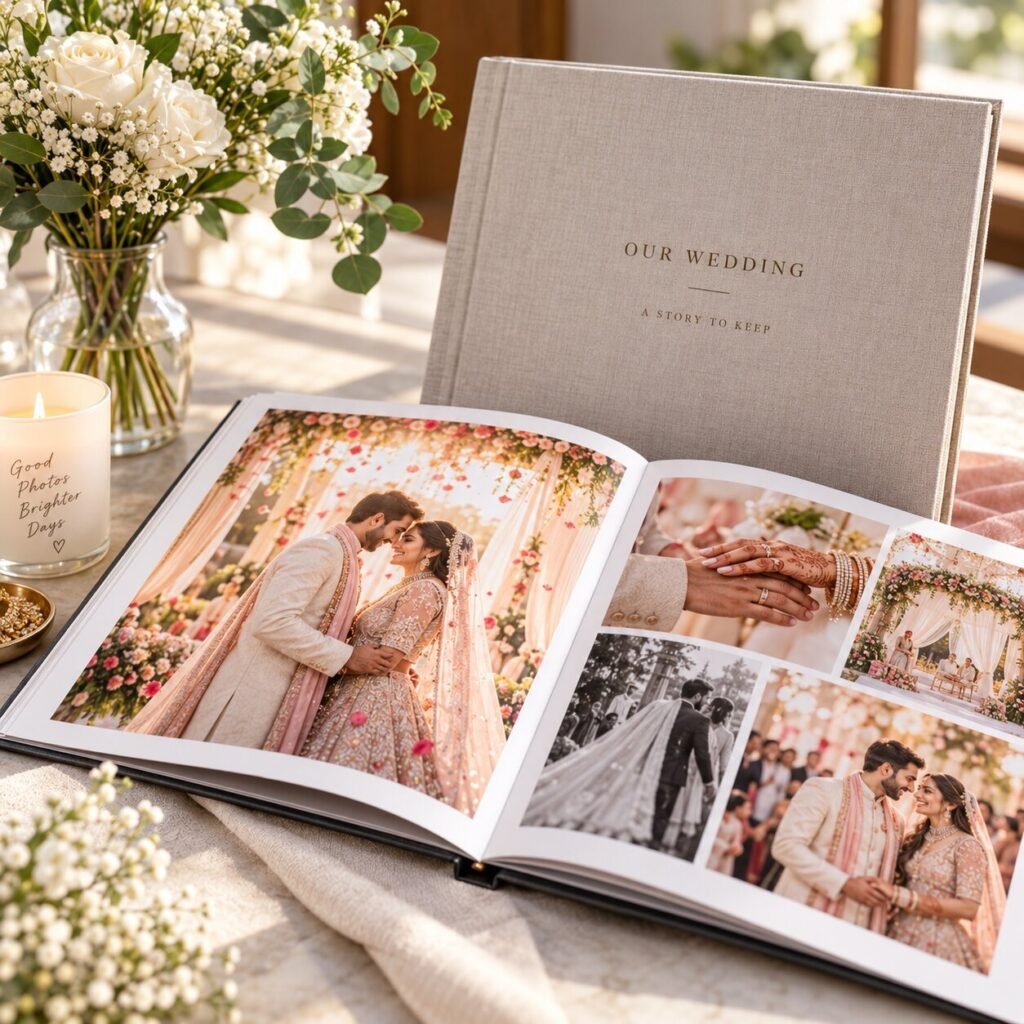
Rather than picking randomly, it helps to think in terms of categories:
- Story photographs — preparation, venue, ceremony, and major events
- People photographs — parents, grandparents, siblings, friends, and important guests
- Emotion photographs — laughter, tears, reactions, and candid embraces
- Portraits — couple portraits and key group photographs
- Details — rings, flowers, invitations, décor, outfits, and jewellery
These aren’t fixed percentages — just a useful framework for making sure the album has variety rather than repeating the same type of shot.
Couples don’t necessarily need to decide on an album immediately after receiving their photographs. Once they’ve had time to review the full collection, they can choose the images that best represent their story and explore options for creating a photo album book that brings those memories together in one place.
Questions to Ask Your Wedding Photographer Before Printing
- Are the delivered files high resolution?
- Which images work best as large prints?
- Which photographs would you recommend for an album?
- Can you help with album sequencing?
- Do you provide album design as part of your service?
- Are there any printing restrictions in the contract?
- Which file format should be used for printing?
- Would a lay-flat format suit these particular photographs?
- Can additional copies be ordered later?
- How should the digital photographs be backed up?
Don’t Confuse a Digital Gallery With a Backup
One of the most overlooked risks is treating a photographer’s online gallery as a permanent archive. Depending on the photographer and gallery service, online galleries may only be available for a particular period or may eventually become inaccessible. That’s why couples shouldn’t treat the photographer’s online gallery as their only backup. Before assuming your photographs are safe:
- Download the full-resolution collection.
- Keep one local copy on a personal device.
- Maintain a separate backup in another location.
- Consider a reputable cloud storage service as an additional layer.
- Don’t rely on the photographer’s online gallery as your only copy of the photographs.
The Best Approach: Keep Both
Digital galleries and printed albums aren’t in competition — they solve different problems. The gallery keeps the complete delivered collection of your wedding photographs, making them easy to access, download and share. The album turns your favourite moments into something you can hold, display, and pass down. Used together, they cover both the practical and the sentimental sides of preserving your wedding memories.
Frequently Asked Questions
Are digital wedding galleries better than printed albums? Neither is universally better. Digital galleries are ideal for accessibility, sharing, and preserving the complete collection, while printed albums provide a physical way to revisit selected memories.
Do I need a wedding album if I already have digital photos? A digital collection preserves the complete delivered set of your wedding photographs, but a printed album creates a curated physical keepsake that can be shared and revisited without a device.
How many photos should be in a wedding album? There’s no universal number. The ideal selection depends on album size, page count, and layout — the goal is to choose photographs that collectively tell the story.
What photos should go in a wedding album? A mix of couple portraits, family photographs, candid moments, ceremony highlights, venue details, and images that capture the emotion of the day.
Is a lay-flat wedding album worth it? It can be especially useful for photographs designed across two-page spreads, since the pages open more fully without a crease through the image.
Should I keep both digital and printed wedding photos? Yes. Digital files are useful for storage, sharing, and accessibility, while a printed album provides a tangible, curated record of the wedding.
How should I back up my wedding photographs? Download the original, high-resolution files and keep multiple copies in separate locations — such as local storage and a reputable cloud service.
Can I create a wedding album from my digital gallery later? Yes. Couples don’t necessarily have to create an album immediately after receiving their photographs. Once the initial excitement has settled, reviewing the gallery again can make it easier to identify the images that deserve a permanent place in a printed album.
Conclusion
A digital gallery and a printed album aren’t competing for the same job. One keeps the complete delivered collection of your wedding safe, searchable, and easy to share with people far away. The other turns a handful of your favourite moments into something you can actually hold, open, and pass on. The couples who get the most out of their wedding photographs tend to be the ones who don’t have to choose — they keep the gallery for everything, and build an album for what matters most.